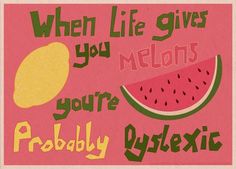
Being dyslexic is not easy.
I would know.
I am one of the 700 million people in the world born with the language based learning disability.
As a result of this, I spent the former part of my life believing I was stupid and the latter part trying to come to terms with that feeling of inadequacy.
October is Dyslexic Awareness Month and speaking as a person who was taught about dyslexia the hard way – through life experience and Google – I can say with certainty that people with dyslexia are not stupid, they are just different. Dyslexia is more than just a spelling disability.
It affects your memory. I have an awful short-term memory but a fantastic long-term memory. It affects your spatial skills. Aside from being directionally challenged, my inability to quickly figure out the difference between left and right is the main reason why I don’t drive.
Above all things, dyslexia affects your self-esteem. Having a learning disability is hard enough, but when you live in a country where the people do not recognise your problem and cast you off as abnormal and stupid, it could cause a damaging blow to your self-esteem – especially if you are a child.
I did not get diagnosed as dyslexic until I was 18-years-old and attending the University of the West Indies (UWI). Before that I was operating under the idea that I had a “spelling problem,” which to be honest was pretty shameful in my mind, especially since my mother was a teacher.
When I was in primary school my mother, took me to every educational specialist she knew to diagnose my problem. However, no one was able to definitively say what was wrong with me until I was an adult.
Like autism, dyslexia is spectrum and I am on the “milder” side of the learning disability. That in itself was problematic because most of the specialists could not diagnose me.
I must have been about seven-years-old when I was in a waiting room with my mother to see another specialist when I asked her what was wrong with me. She tried not to look sad when she told me nothing was wrong, but even at that age I knew she was lying.
To save me from spelling, my mother pushed me towards mathematics – a subject that I excelled at, but I could never see a future in that field.
I made it up to university level with Maths, but depression caused by my dyslexia put me near the point of failing school. That was where UWI’s Academic Advising and Disability Liaison Unit (AADLU) intervened. They screened me and told me that their tests showed that I had a high possibility of having dyslexia.
As a result of this, I underwent further, more expensive tests, which did indeed confirm that I was dyslexic. For the first time in my life I was relieved. Finally someone was able to give me definitive answers to a problem that had been plaguing me all my life.
I was always indecisive about what I wanted to do for a living. As a teen while all my other classmates were determined to become doctors or lawyers, I flip-flopped on careers every few months. I know that is something normal for someone at that age, but for me it really was not indecision as much as insecurity.
One day I wanted to be an astronomer and a writer, the next, I wanted to be a genetic engineer and a writer. I never took the idea of being a writer seriously because I thought a person like me, who could barely spell the word conclusion, could not properly write a conclusion for a story. Eventually, as my confidence grew, and through a lot of therapy, I dropped the fluctuating careers and decided to be a writer.
It was not easy to get over the spelling of words and just write, but that was the best advice I ever got as a writer. It was my mother, one day, who told me not to bother about how the words were spelt and just write them down.
My mother is the only reason why I was able to not let my disability become debilitating. When my teachers cast me off as stupid, she taught me. I was never as fast as the other students when writing and I could not copy off the black board like they could. I sucked at dictation, and the worst was reading out loud and stumbling over simple words that other children used to know. When all the other teachers – particularly my Standard Five teacher – cast me off as stupid, my mother was there as my support and teacher.
My mother would pick me up from school and copy my notes off the blackboard. She would sit down with me and teach me the difference between “ee” and “ea” words, and she taught me to take my time and sound out words to spell phonetically – a method that is not 100 percent effective, but it was still a lot better than jumbling up my letters.
Dyslexia is hereditary. I inherited it from my father and my cousins got it from their parents. Chances are if you or your children are dyslexic, then other members of your family are too. I have learned that my father’s family is full of brilliant dyslexic writers. I guess we never let any jumbled up letters hinder us from writing what we wanted to say.
People still ask me how I managed to become a journalist with a Master’s degree while being dyslexic. My response is the same all the time. My parents believed in me. My mother had the patience to sit down with me and painstakingly teach me how to read and write. She loved me enough to support me in every step of my education and career. My father read to me and showed me how to love stories despite hating writing. Eventually I realised that I did not hate writing, but I was afraid of spelling.
One piece of advice I would give for dealing with people with dyslexia is to accept their differences. I’m not just saying don’t be frustrated and keep your calm with them. That should be a given. I am saying accept the fact that person thinks differently, remembers differently and sees the world in a unique perspective and that difference should be celebrated, not fixed.
People with dyslexia learn in different methods. I am an auditory learner. I easily understand and remember information I hear. Dyslexics also have a different sense of recall. We can’t remember what we said five minutes ago, but we can tell you what you were saying last week. It can be an annoying trait, but most people with dyslexia have an above average long term memory. Most dyslexics are usually messy and disorganised. I don’t know why. It has never bothered me, but I know it certainly drives my mother and sister insane.
Having dyslexia is nothing to be ashamed of. That is one thing I have finally learned. I remember feeling so bad about myself for not being able to spell a simple word like queen – I used to spell it “quean.” I realise how ridiculous it was for me to be ashamed of these things. I also don’t know how to spell ridiculous, but spell-check is a fantastic invention.
I am proud of being dyslexic. What I lack in sequencing and spatial abilities, I gain in many ways. I have a stellar memory that allows me to relate facts and scenarios that happened years ago – I just need to sleep on that information. I have a natural ability for logic and mathematics. While many people struggled with algebra I aced it – thank you dyslexia. Most importantly for me, I think differently from my friends and family.
Dyslexics have a different way of perceiving situations and the way we understand the world. Some may see it as a bad thing, but I think that those different perspectives make the world more interesting.
 Rachael Espinet
Leave a comment